

September Feature: Ashaki M. Jackson
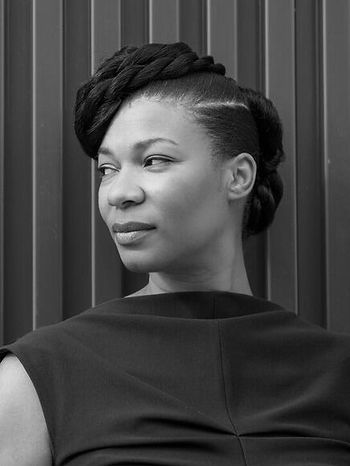
We are proud to have Ashaki M. Jackson as our featured artist of September!
Ashaki M. Jackson, Ph.D., is a social psychologist, program evaluator and poet. She has worked with youth moving through the juvenile justice system through research, evaluation and creative arts mentoring for one decade. Her work has appeared in CURA: A Literary Magazine of Art and Action, Pluck! Journal of Affrilachian Arts and Culture and Prairie Schooner among other journals and anthologies. Writ Large Press published her chapbook, Surveillance, in March 2016, and her second chapbook, Language Lesson, is now available from MIEL. Jackson is also co-founder of Women Who Submit, a community that supports women in submitting their literary works to top tier journals. She earned her MFA (poetry) from Antioch University Los Angeles and her doctorate (social psychology) from Claremont Graduate University. She lives in Los Angeles.
Q: We’re excited to be featuring you for the month of September! Let’s get started: can you tell us a bit about yourself, your background, and how you got into writing?
A: I'm unwittingly an Angeleno; I've resided in Los Angeles for nearly 15 years. My intent was to leave after completing graduate school, but I failed at this miserably. I'm an applied social psychologist by training. My research focus has been youths' trajectories toward incarceration and where along that path interventions can be most useful to prevent situations that lead to arrest.
I am also a poet. I think the rule is that I'm an emerging poet until my first full collection is published. So, I'm emerging in my late thirties, which is always fun to say. I came to poetry long before psychology. In part, it was my interest in linguistics that encouraged my writing. I was curious about the musicality of word-sounds---how syllables and silence were meaningful in writing and how I might use this in storytelling.
As I was completing a doctorate in psychology, I decided to co-enroll in a low residency MFA program to spend concerted time with creative writing. My poetry studies served as a respite from my focus on the juvenile justice system.
Q: I'm also an Angeleno. Though nowadays, I feel like the East Coast is more home for me. Is there a particular place you feel most at home?
A: I'm most at home with my parents, which is a very young thing to say. We're in this space where I pry into their pasts and gobble up every story. It's nice to hear their trajectories to how they became such amazing people. With them, in their ranch style home, eating this ornate take-out pizza from a neighborhood restaurant is home. When I'm not there, I feel very nomadic and unrooted. I try to make myself feel better by saying adulthood is about journeys, but I really want to eat pizza topped with five meats and listen to my parents.
Q: Very interesting. In your chapbook, Language Lessons, you evoke the past in beautiful but often violent ways, especially in reference to the body - the cracking of ribs, the sewing back of skin - the body, which I say is in itself a home. What is the burden of home? And please let me know if I'm reading your work wrong!
A: Yes, this collection is about the body---my late Grandmother's body---but more so the way her loss left us reeling. That it lands as violence upon your reading is totally unintentional.
I allude to a few things about the body in the work that I think work in tandem to evoke a sense of desperation after loss. The allusions: My grandmother had a mastectomy after her third challenge with breast cancer, and she experienced a heart attack later in life, so the poems are washed with the theme of a body's malfunction. There is also allusion to the body as food. I spent quite a bit of time studying endocannibalism as a mortuary rite in parts of the Amazon. I actually studied several mortuary rites in search of one that felt more appropriate than a traditional cemetery burial. I juggled several ideas here, and this is the desperation I wanted to convey. In loss, we assemble what we know and what we think we know to make ourselves feel better. Desperation, malfunction, hunger, disorientation---these feelings were simultaneous for me after her death.
There was a little peace in the writing, where I simply unearthed the coffin again and again, so to speak. There was more peace in being home with my parents. We had all experienced that loss, and there is comfort in that. I gave myself permission to unravel in the space that they created for me -- for us -- over decades. It was our home. It was my grandmother's last home. It was quiet and full of her scents. I needed that physical space and to feel like a cared-for child.
Q: In the Prairie Schooner, you wrote once that the body has a "demonstrative vernacular" in grief. Can you elaborate?
A: I mean that the body still communicates in the absence of language. I remember thinking to myself that I was wearing a foreign body because of the way I grieved. I would sleep with my knees to my chest. I was never fully upright whether sitting or standing. I had a voice, but I preferred not to open my mouth. I burst into tears at the scent of coffee because coffee was a ritual of the living grandmother now gone. My ears hated all sounds but wind. My body conveyed the sadness that I couldn't articulate. It had a separate performance I could not control. I looked broken and did not need to say "breaking."
Q: What are some things you've always wanted to be asked?
A: Those who are closer to me might ask how my introversion shapes my work, or how writers with full-time positions in other fields maintain a writing practice. People who don't know me but have read my work might ask about the devices that bring silence into my work, or the choice to make such personal laments public. Off-topic questions that I think would be fun to answer include what playlist would I create to accompany my chapbook collections or in what public places I might leave my more subversive work.
Q: What is the responsibility of the writer?
A: I cannot speak for all writers, but my responsibility is to write pain in the context, texture and season in which it exists. If the pain is a soft creeping, then the writing should mimic a soft creeping. If the pain is specific to a season of inflamed racism, for example, then the writing will echo that season. My responsibility is to be as honest to the content as a photograph would be to an image.
Q: What advice would you give to our (predominantly young) readers?
A: Read everything. There is a book I love that is written in Spanish. Another is written in columns. I have a shelf full of Stephen King books, another shelf dedicated to chapbooks of all genres, and another devoted to Latin American literature. The Complete Collection of Shakespeare. Read multiple versions of high school history books and at least three versions of The Bible. Read other peoples' holy books. Build a literary intelligence for your mental health.
Q: When do you know that a poem has fully realized itself?
A: In my process, I'll revise a poem to what I believe are its essentials---the core of what needs to be said without excessive flourish. Then I locate the ending, which might actually be tucked in the center of the poem. You can find the ending by reading the poem aloud and listening to your breath's cues. The poem will tell you where it ends, and you should honor that guidance. When I situate the ending of a revised poem where the poem instructs, then its done. (But secretly, I have tinkered with lines after a poem has been published. What do I know?!)


Comments